
Security and trust
Built for the people who review vendors.
OPPTIQ separates each customer’s data in the database itself, checks access at several independent layers, records important actions in a tamper-evident audit log, and keeps a person in charge of everything AI proposes.
OPPTIQ is building towards ISO/IEC 27001 and SOC 2. We do not yet hold a certification, and we are happy to complete your security questionnaire and share our security documentation.
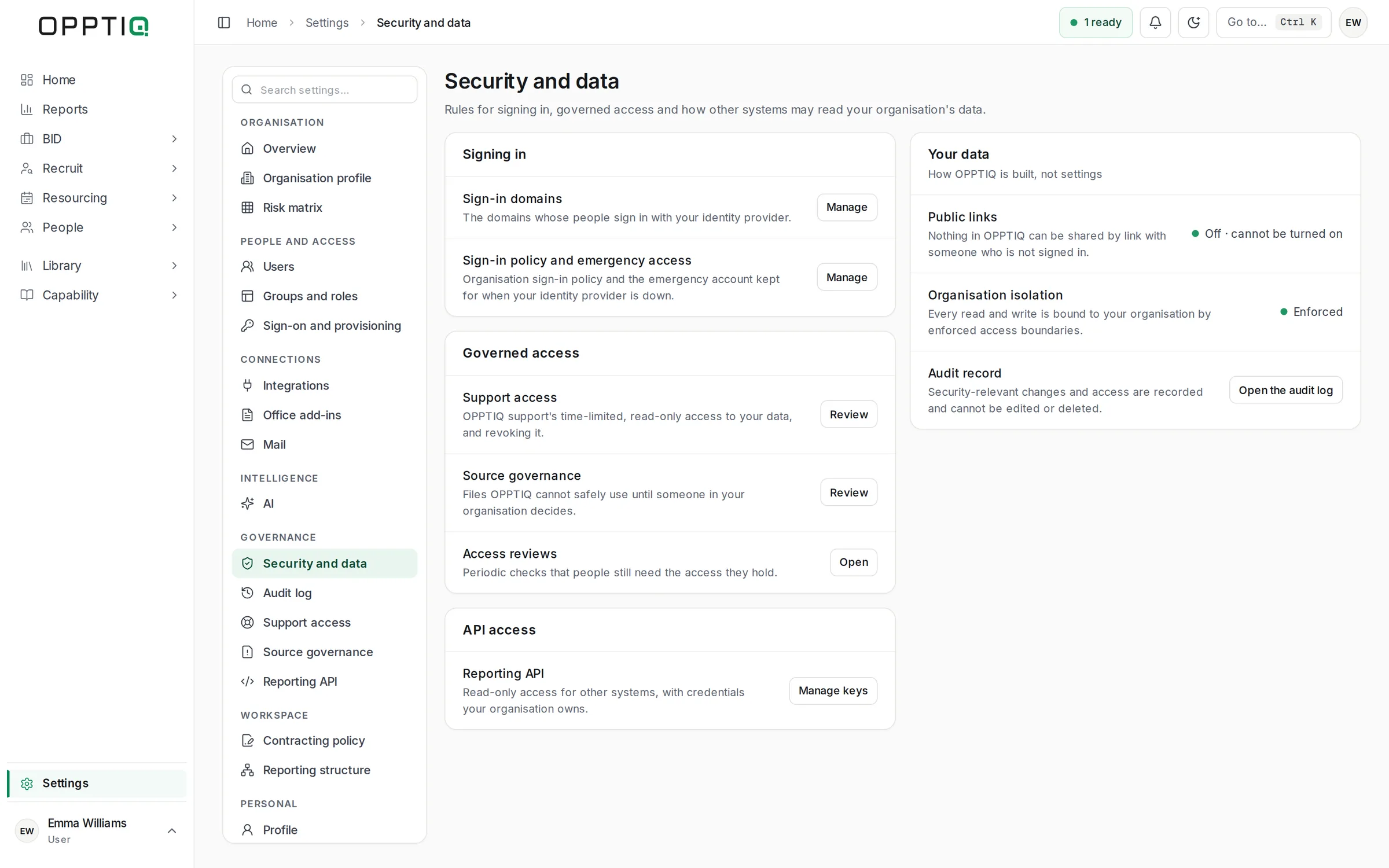
Customer data isolation that fails closed.
Every organisation’s data is separated by PostgreSQL row-level security, enforced on every table that holds organisation data. Without a verified organisation context, a query returns nothing.
- The application connects as a database role that cannot bypass isolation.
- Records are tied to their organisation by the database’s own keys.
- Background services run as named identities, with only the permissions and organisations they need.
- A certification suite re-tests cross-organisation isolation automatically.
Access is decided per opportunity.
People see only the bids and areas they are given. Sensitive areas need their own grant, approvals need a named responsibility, and an administrator can deny any single permission on one bid.
How the five permission layers work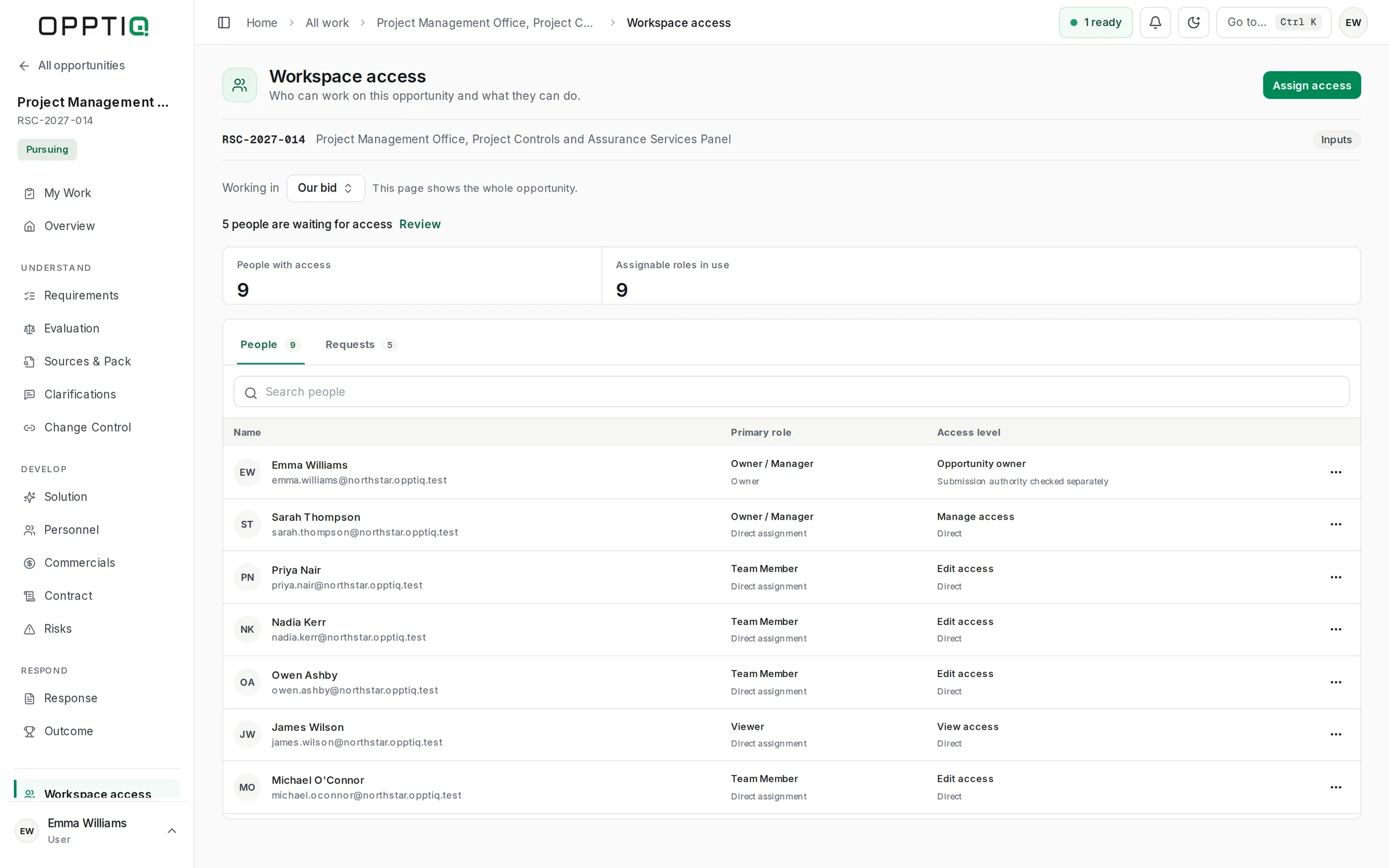
Five independent checks on every request.
Each layer works on its own, so one mistake doesn’t open the door.
- 1A single sign-in gateway. The API rejects any request that does not come through it.
- 2Roles, grants and responsibilities on the opportunity.
- 3Explicit denial rules that override any role.
- 4Organisation-scoped data access in the application.
- 5Row-level security in the database.
AI does the reading. People keep the authority.
AI analysis uses OpenAI models through OpenAI’s API, under a recorded isolation policy, called only from a small, controlled part of the platform.
- Search and people-matching embeddings are computed inside OPPTIQ, so that text is not sent to an AI provider.
- Each customer has a recorded AI isolation policy before any AI runs. A dedicated AI environment is available where agreed.
- Every analysis is estimated and budgeted before it runs, and stops at its budget, keeping finished work.
- AI never writes directly to the bid. Its output is a proposal people review.
- Every AI-derived item links to the exact source passage, or says plainly when it can’t.
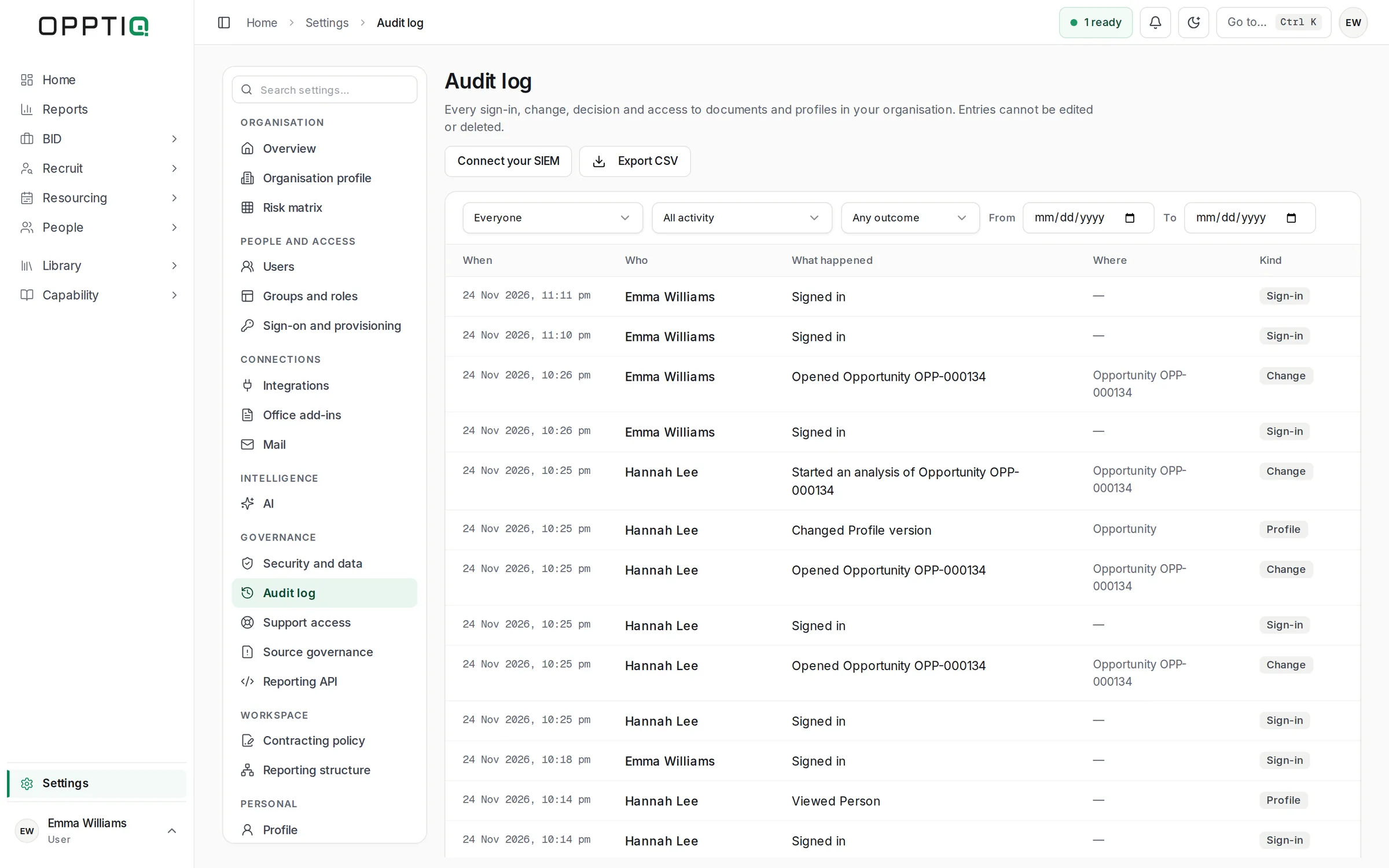
Audit and accountability.
Security, access and governance activity is written to an append-only, hash-chained audit log for each organisation. The database refuses edits and deletions, and tampering can be detected.
- More than 160 kinds of action are recorded.
- Administrators can view and export the log as CSV, and both are audited.
- AI interpretations, decisions and approvals keep their source and history.
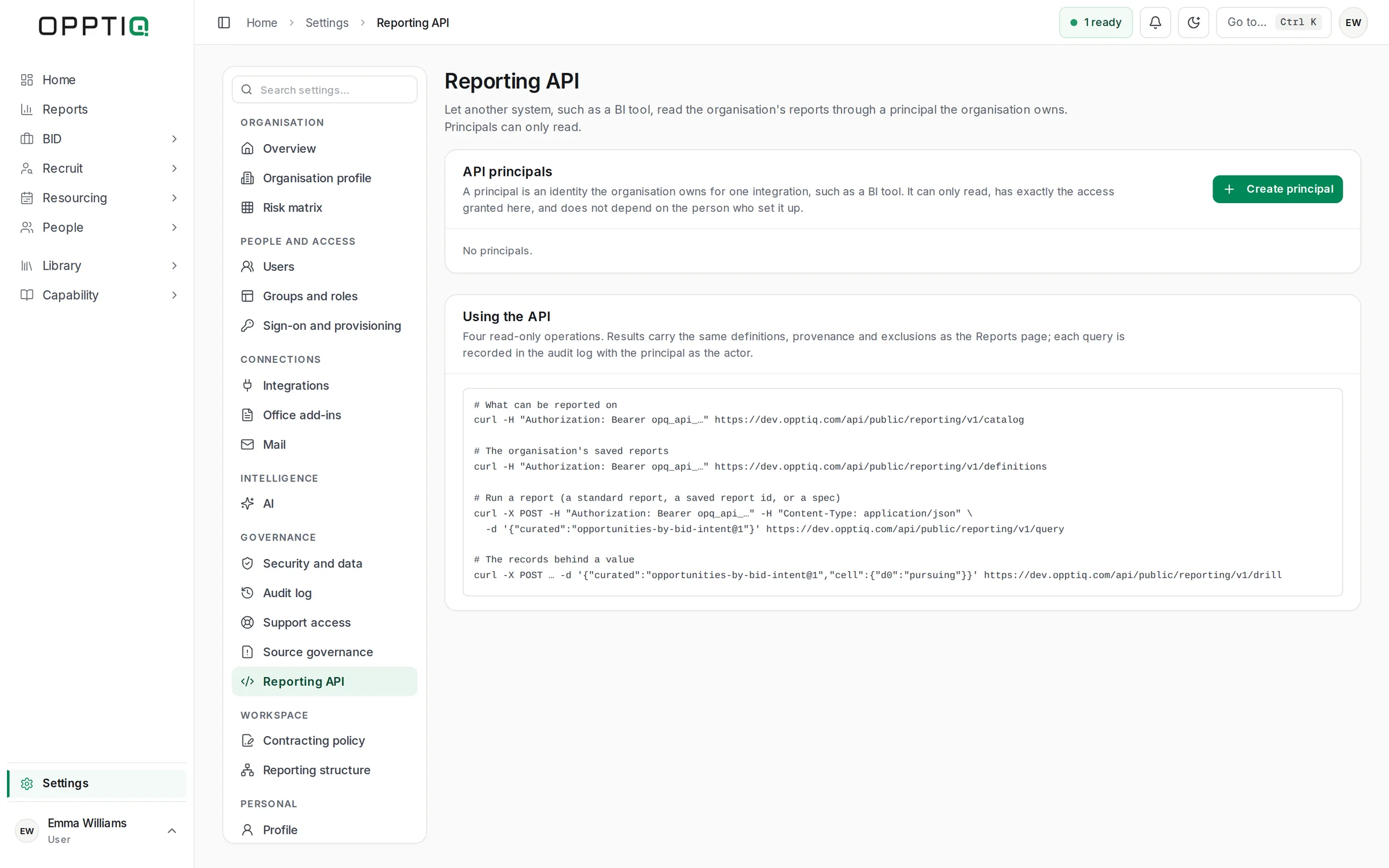
Your SIEM pulls the audit trail.
Your SIEM can pull audit events through the read-only Reporting API, using an API key your organisation owns. Each query is itself recorded in the audit log.
OPPTIQ does not push events to a SIEM, and there is no packaged Microsoft Sentinel or Splunk connector.
Platform and hosting.
Only the web gateway is reachable from the internet. The database, cache, file storage and processing services sit on a private network.
Ask us about hosting and residency options- Traffic is encrypted with TLS 1.2 or higher, with HSTS and other security headers.
- Deployment secrets are encrypted, and production keys are kept separate from development keys.
- Stored integration secrets are encrypted with AES-256-GCM.
- Files from SharePoint and email attachments are scanned for malware before processing.
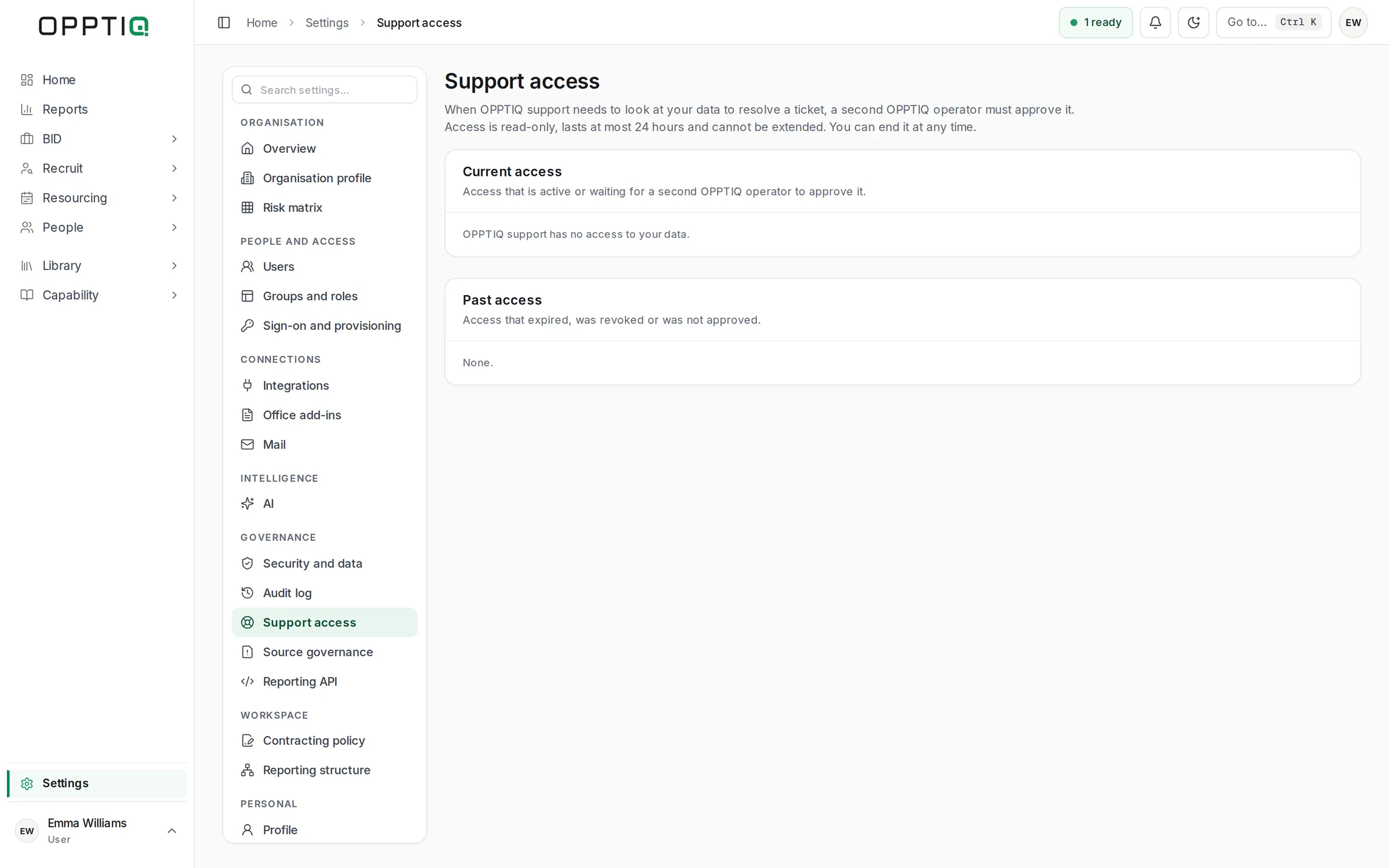
No standing access for our support team.
When OPPTIQ support needs to look at your data, a second operator must approve it. Access is read-only, lasts at most 24 hours and cannot be extended, and you can end it at any time.
Reviewing OPPTIQ for your organisation?
We’re happy to complete your security questionnaire and share our security documentation.